Auto Attendants
Auto Attendants are the IVR routing workhorses of most PBX systems: they greet callers, offer menu choices and route calls to people, groups, mailboxes and other services.
How Auto Attendants work
Every auto attendant has an extension, one or more menus, and one or more schedules.
- Menu:
What the caller hears (the greeting) and what each key does
- Schedule:
When a menu answers, for example open hours, after hours or a holiday
When a call comes in, the auto attendant checks its schedules to pick a menu, plays that menu’s greeting, and then acts on the keys the caller presses.
Phone numbers point at an auto attendant’s extension. Callers on your own phones can also dial the extension directly.
Tip
Set up your menus first, then your weekly hours, then “everything else”, then closures and holidays. The builder shows this suggested setup order on a new auto attendant.
The Auto Attendants list
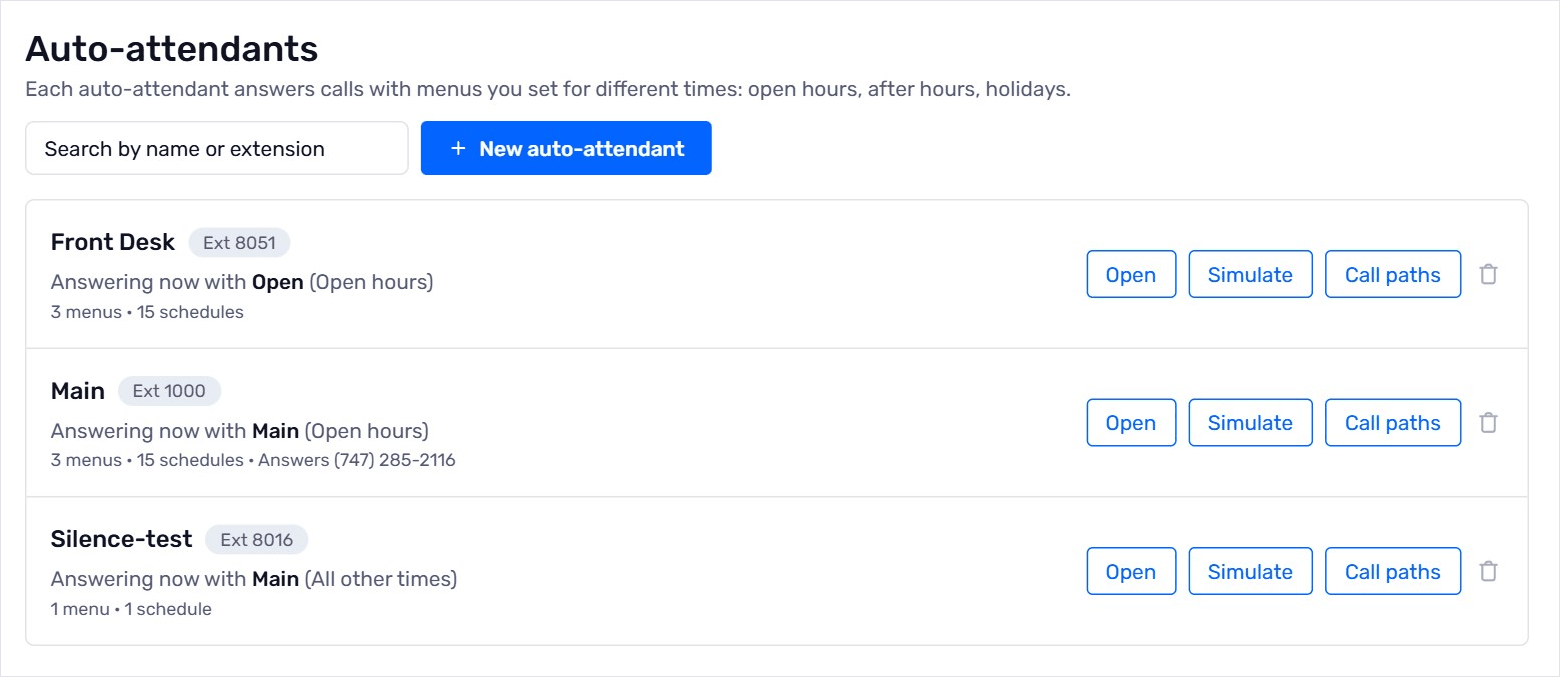
Settings > Auto-attendants lists every auto attendant on the account. Each one shows:
Its name and extension
What is answering right now, and which schedule (or the manual override) picked it
How many menus and schedules it has, and the phone numbers that point at it
An Override on badge when the manual override is switched on
From the list you can Open the call flow builder, Simulate a call, or view Call paths. Use the search box to find an auto attendant by name or extension.
Warning
Deleting an auto attendant stops calls to its extension, and to any phone numbers pointing at it, right away. Point your numbers somewhere else first.
Creating an Auto Attendant
Click New auto-attendant, give it a name, and check the extension. The extension is filled in with the next free extension on the account. Click Create and open builder to go straight to the call flow builder.
A new auto attendant answers nothing until it has a menu and a schedule. No phone numbers point at it until you change them, so you can build and test it first.
The Call Flow Builder
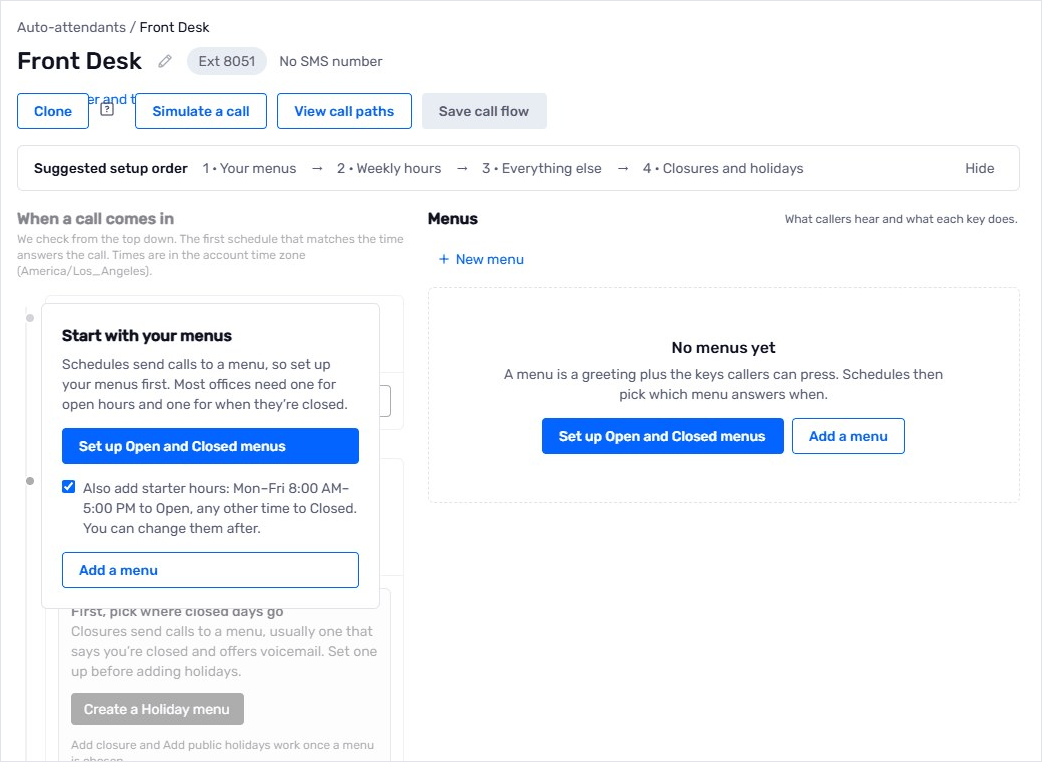
The call flow builder is where you edit a whole auto attendant on one page: its schedules on the left, its menus on the right, and a Call flow check that lists anything that needs attention.
Changes are not live until you click Save call flow. Until then the page shows Unsaved changes, and Discard puts everything back the way it was saved.
Important
Saving changes what callers hear right away. For larger changes, Clone the auto attendant first, make your changes on the clone, test it by dialing the clone’s extension, and then point your phone numbers at it. Keep the original until you’re happy, so you can switch back.
The header shows the auto attendant’s extension, the phone numbers that answer here, and its SMS number and tags. Click the pencil to rename it, or SMS number and tags to change those.
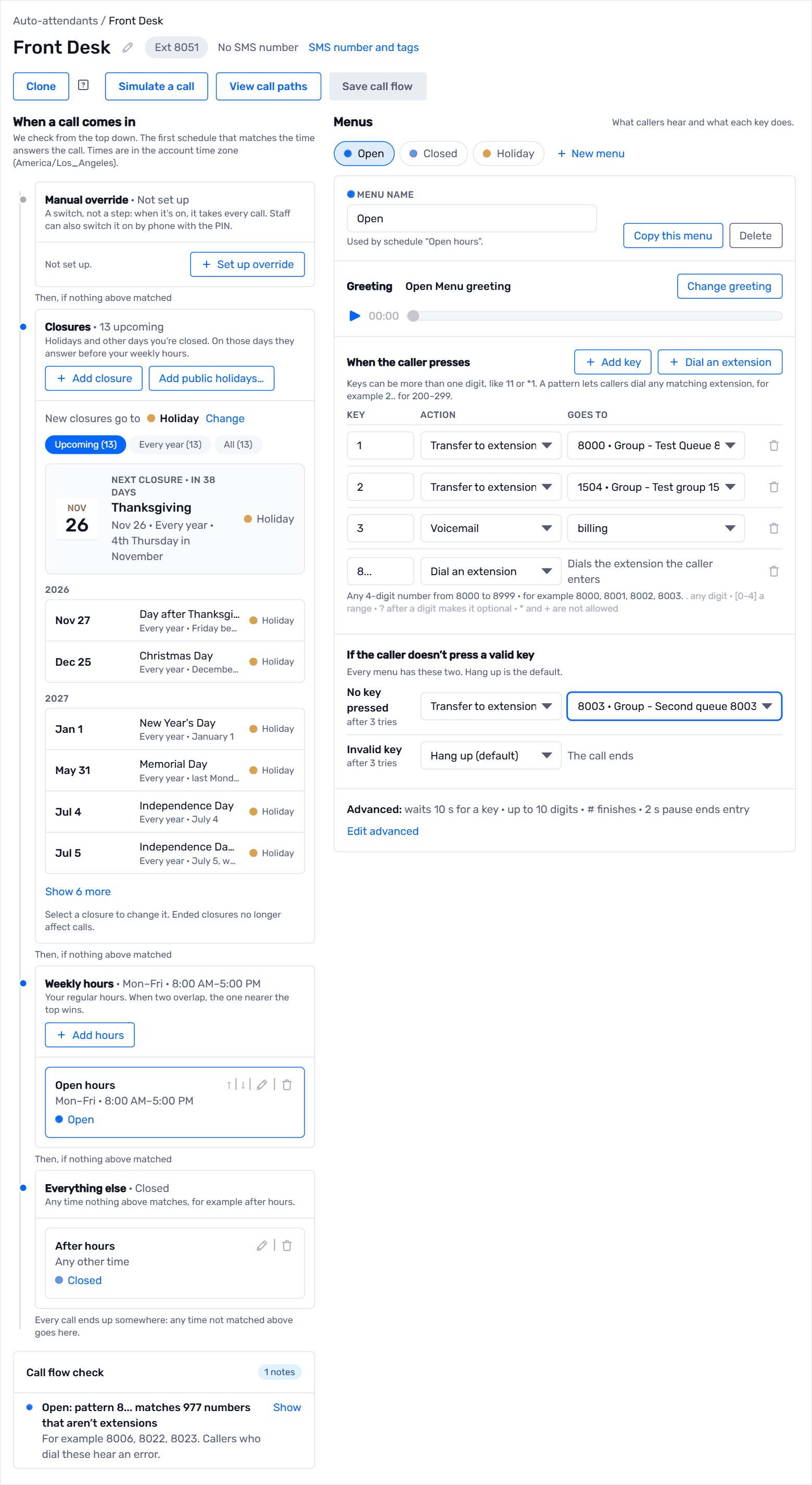
Getting started: no menus yet
On a new auto attendant there are no menus yet, so the schedules are greyed out with a Start with your menus card. Schedules send calls to a menu, so the menus come first.
- Set up Open and Closed menus:
Adds two menus, “Open” and “Closed”. With Also add starter hours ticked (the default), it also adds weekly hours, Monday to Friday 8:00 AM to 5:00 PM, going to Open, and an “everything else” schedule going to Closed. You can change all of them afterwards.
- Add a menu:
Adds one empty menu.
Next, record a greeting for each menu.
When a call comes in: the schedules
The schedules column shows the order the phone system checks things when a call arrives. It checks from the top down, and the first schedule that matches the time answers the call. Each section says, in its heading, what it currently does.
The sections are not setup steps. They are always checked in this order:
Manual override: when switched on, it takes every call (see Manual Overrides (night mode)).
Closures: holidays and other days you’re closed. On those days they answer before your weekly hours.
Custom rules: only shown when the auto attendant has schedules made with advanced time fields (see Custom rules).
Weekly hours: your regular hours. When two overlap, the one nearer the top wins.
Everything else: any time nothing above matches, for example after hours. Every call ends up somewhere: this catches any time not matched above.
Important
Without an Everything else schedule, calls at times no schedule matches are not answered by the auto attendant. The call flow check warns about this.
Click a schedule to open it. Every schedule has:
- Name:
A name describing the schedule
- Menu:
The menu that answers when this schedule matches
- Ring an extension before the menu answers:
Optional. Rings an extension (a user, group or other service) for the number of seconds you enter. If nobody answers, the menu answers.
Use the arrows to move a schedule up or down within its section. Times are in the account time zone.
Note
When you save, schedules are stored in section order. If an older auto attendant had them in a different order, a banner lists the schedules that will move before you save.
Weekly hours
Add hours adds a schedule for Monday to Friday, 8:00 AM to 5:00 PM. Change it to suit:
- Days:
Click the days the schedule is active. No days picked means every day.
- All day, or From and to:
The hours it is active on those days.
- Repeats:
Every week or Every other week. Every other week is on every second Sunday-to-Saturday week, and the builder shows the next days it’s on. On the off weeks the schedule is skipped and calls go to the next schedule below it, so add an every-week schedule under it for the other weeks.
Closures and holidays
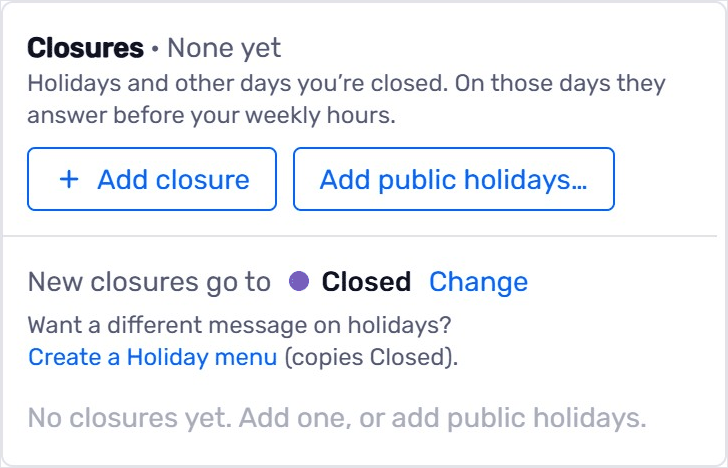
Closures are days you’re closed: holidays, a staff day, an office move. Each closure sends calls to a menu, usually one that says you’re closed and offers voicemail.
At the top of the Closures section, the builder shows where new closures go:
If no menu looks like a closed-day menu yet, it says First, pick where closed days go. Click Create a Holiday menu, or pick an existing menu. Add closure and Add public holidays work once a menu is chosen.
Otherwise it says New closures go to the chosen menu, with Change to pick another. The builder picks the menu your closures already use, or a menu named like Holiday, Closed or After hours, or the menu “everything else” goes to.
To play a different message on holidays, click Create a Holiday menu. It copies your closed menu, keys and all, so only the greeting needs changing.
Add closure
Adds a closure for today, all day. Each closure can go to its own menu.
- First day closed and Last day closed:
The days you’re closed. For one day, set both to the same date.
- Closed all day, or Closed from:
Untick Closed all day to close partway through the first day, from the time you enter. The other days are closed all day.
A closure ends at midnight after the last day. Closures added from Add public holidays with Every year repeat each year; their dates can’t be changed, so delete one and add it again to change it.
Add public holidays
Opens a list of public holidays for your country, and optionally your state or region. The holidays most offices close for are ticked. Choose:
- Send calls to:
The menu for these days. It starts with the menu shown at the top of Closures.
- Every year:
One rule per holiday that never needs updating, for example “4th Thursday in November”. Recommended.
- Next date only:
One-off dates. Add them again next year.
With Also close the nearest weekday when a fixed-date holiday lands on a weekend ticked, a holiday on a Saturday also closes the Friday before, and one on a Sunday also closes the Monday after.
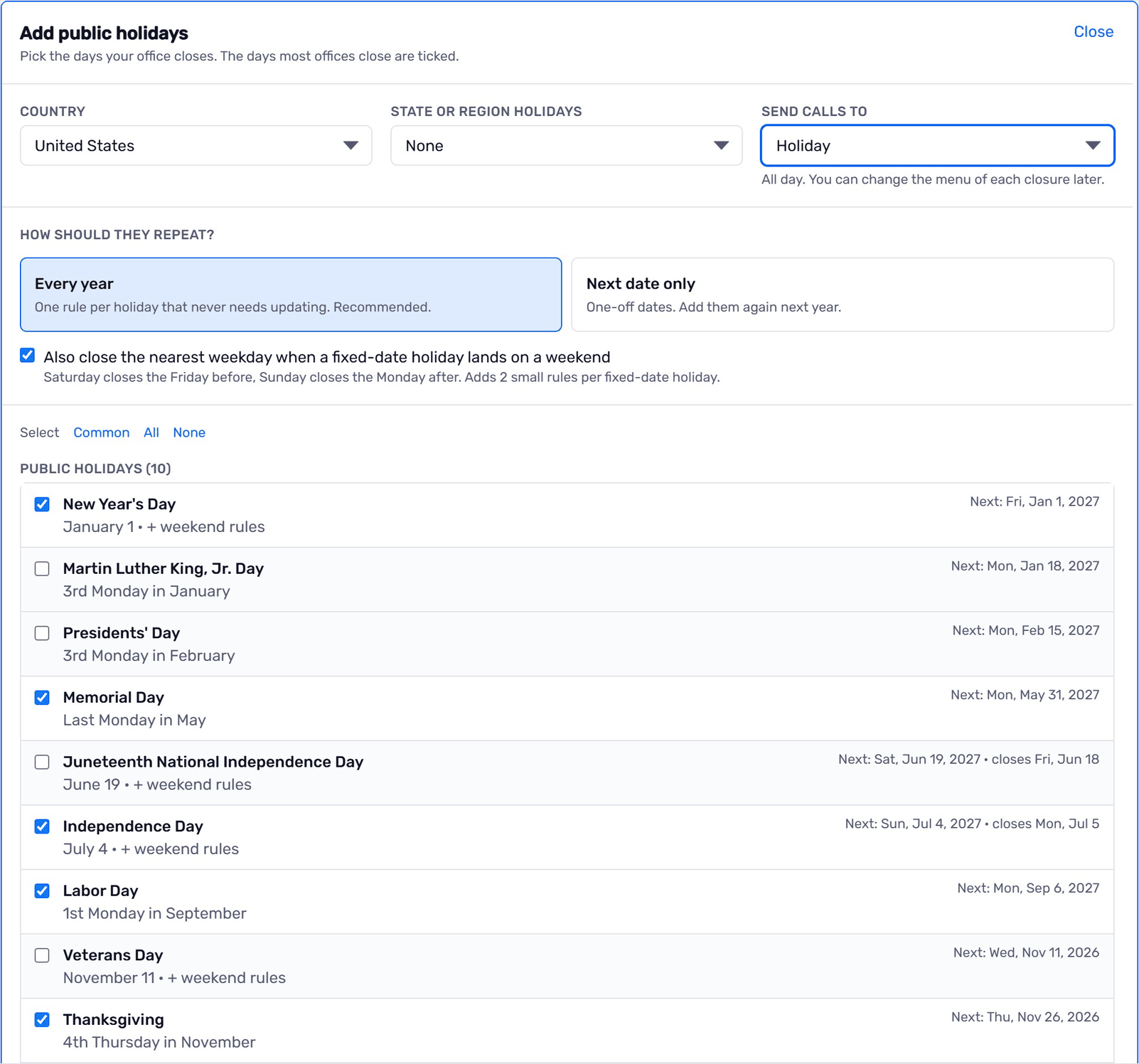
Holidays already added are marked so you don’t add them twice.
The Closures list shows the next closure first, then the rest by year. Use the filters to see Upcoming, Every year, Ended or All closures. Ended closures no longer affect calls. Delete ended removes them all at once.
Menus
Menus play a greeting, then act on the keys the caller presses. Click a menu’s tab to open it, or New menu to add one. Each menu has a colour, which the call paths page uses too.
Under the menu name the builder shows where the menu is used. A menu that no schedule, key or override leads to is never heard. Copy this menu makes a copy with the same keys and greeting. A menu that is still used can’t be deleted: point its schedules, keys and override at another menu first.
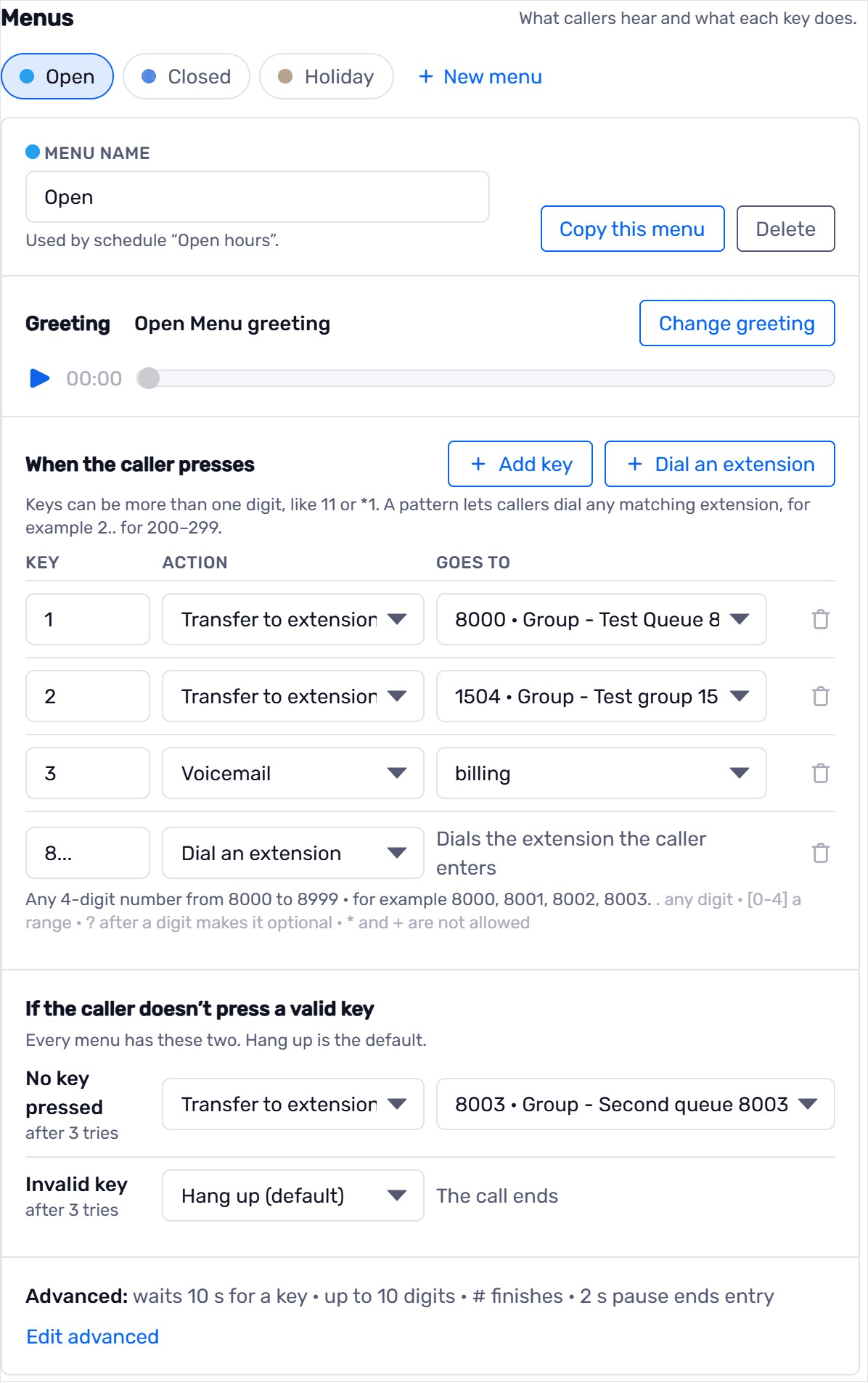
Greeting
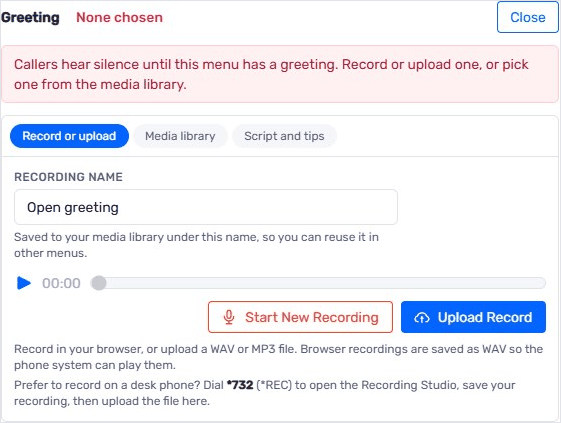
The greeting is the first thing callers hear in a menu. A menu with no greeting plays silence. Click Choose a greeting (or Change greeting) and pick one of:
- Record or upload:
Record in your browser, or upload a WAV or MP3 file. Browser recordings are saved as WAV so the phone system can play them.
- Media library:
Pick a recording already in the account’s media library.
- Script and tips:
A suggested script written from this menu’s keys, with tips for a good greeting.
New recordings are saved to the media library, so you can reuse them in other menus. Give each one a Recording name. It starts as “<menu name> greeting”, and must be different from the recordings already in the library.
Tip
Prefer to record on a desk phone? Dial *732 (*REC) to open the Recording Studio, save your recording, then upload the file here.
Keys
Add key adds the next free key. Keys can be more than one digit, like 11 or *1. For each key, pick an action:
- Transfer to extension:
Sends the call to an extension in the account (user, group, another auto attendant, OnCall group and so on)
- Call an outside number:
Sends the call to an outside phone number, usually a 10-digit number
- Voicemail:
Sends the call to a mailbox
- Play a recording:
Plays a media file from the account’s media library, then the menu continues
- Go to another menu:
Sends the call to another menu, which plays its own greeting and offers its own keys
- Back to previous menu:
Goes back to the last menu (if the caller got here from another menu)
- Back to first menu:
Sends the call back to the menu the caller entered the auto attendant from
- Dial an extension:
Lets callers dial any extension that matches a pattern (see below)
- Dial with a prefix:
Like Dial an extension, but adds a prefix before the digits
- Text the caller:
Sends the caller a text message, then the menu plays again. Needs the auto attendant’s SMS number.
- Hang up:
Ends the call
- Dial by Name:
A voice application that lets callers enter the first letters of a name, reads back the matches using text to speech, and transfers the caller to the one they confirm. Details on this can be found here
Note
When one key starts with the same digits as a longer key (for example 1 and 11), the menu waits a moment for more digits before acting on the shorter key. The call flow check notes this.
Dial an extension
Dial an extension adds a pattern key that lets callers dial an extension directly, for example 2.. for any extension from 200 to 299. The builder suggests a pattern from your extensions.
- .:
Any digit
- [0-4]:
A range of digits
- ?:
After a digit, makes it optional
The builder describes what a pattern matches, with examples. To stop callers placing outside calls through the auto attendant, patterns that could dial any number, or numbers longer than 5 digits, can’t be saved.
If the caller doesn't press a valid key
Every menu has two settings for callers who don’t choose:
- No key pressed:
What happens when the caller presses nothing, after the greeting has played the set number of times
- Invalid key:
What happens after the set number of invalid entries
Each one can Hang up (default), transfer to an extension, call an outside number, go to voicemail, or play a recording. Hang up ends the call after the tries.
Advanced
Click Edit advanced to change how a menu listens for keys:
- Wait for a key (ms):
How long the menu waits after the greeting (1000 = 1 second)
- Wait between digits (ms):
For keys longer than one digit, how long a pause ends the entry
- Invalid keys allowed:
Then “Invalid key” runs
- Times to repeat:
Then “No key pressed” runs
- Longest key (digits):
Must cover the longest key or pattern
- Finish key:
Callers press it to finish entering digits (# by default)
Call flow check
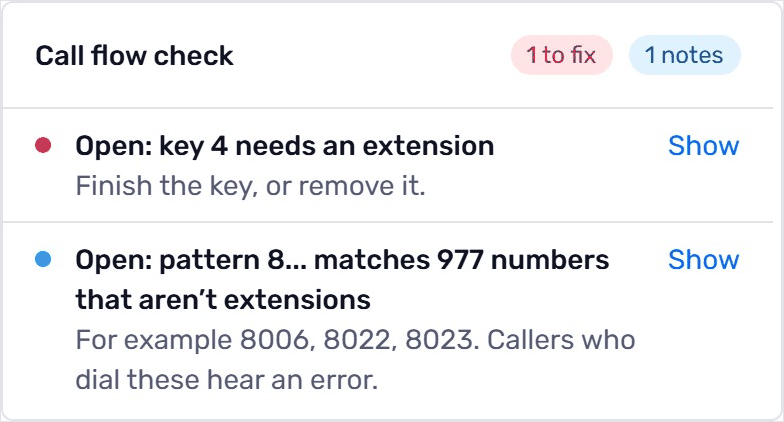
The call flow check reviews the whole auto attendant as you edit and lists what it finds:
- To fix:
Problems that stop a save, such as a key with no extension, a schedule with no menu, or two menus with the same name
- To review:
Things that probably need attention, such as a menu with no greeting, or nothing catching “any other time”
- Notes:
Useful information, such as a menu that isn’t used, closures that have ended, or keys that wait for more digits
Click Show, or the finding’s title, to go straight to the item. The builder opens what’s needed (the menu, the schedule, the override or the closures filter), scrolls to it, and puts the cursor in the field to change.
Testing an Auto Attendant
Both pages below use the saved call flow. If you have unsaved changes, the builder asks to save them first.
Simulate a call
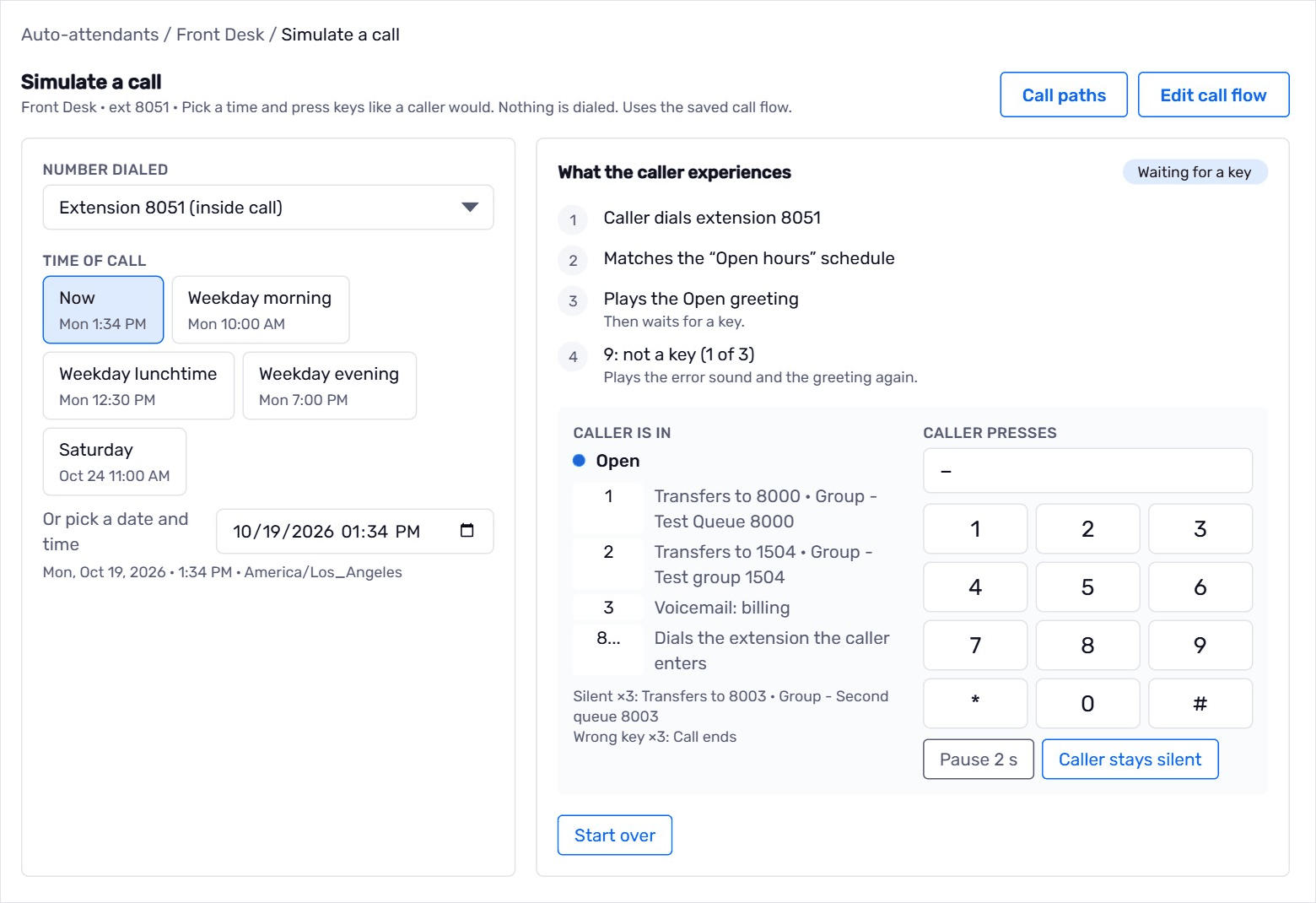
Simulate a call walks through a call step by step, without dialing anything.
Pick the number dialed (one of the auto attendant’s phone numbers, or its extension from inside the account) and the time of the call: now, a weekday morning, lunchtime or evening, a Saturday, or any date and time you choose.
Optionally turn the manual override on, or have the ring-first extension answer.
Press keys on the keypad as the caller would, pause, or stay silent.
What the caller experiences lists each step: the schedule that matched, the greeting, each key and where it leads. Alongside, it shows the menu the caller is in now and what each key does.
Call paths
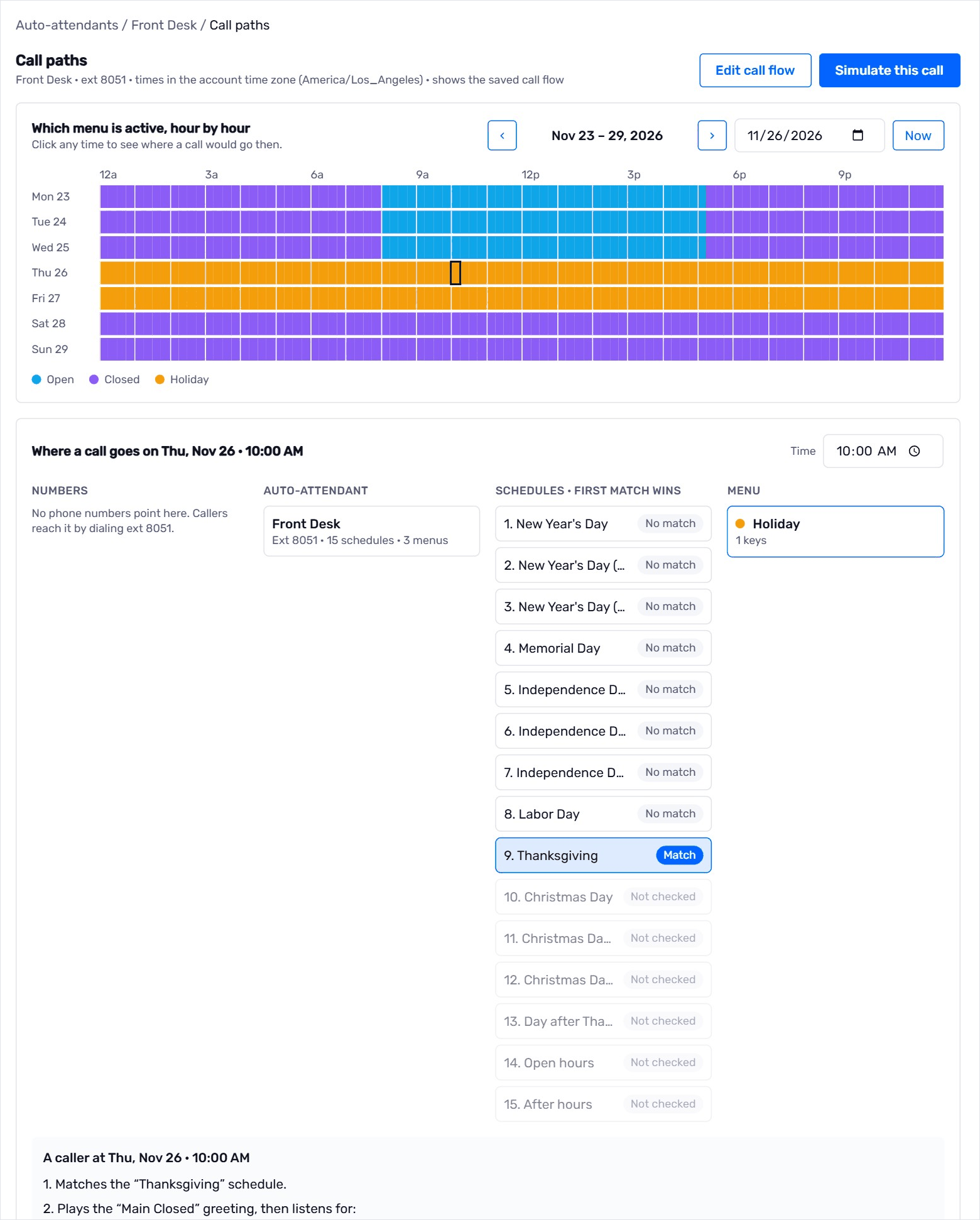
Call paths shows which menu is active, hour by hour, for a whole week, in the menus’ colours. Move between weeks, pick a date, or click Now. Times that no schedule covers are shown as not answered.
Click any time to see where a call would go then: the numbers, the auto attendant, the schedule that matches and the menu that answers, and what a caller at that time hears and can press. Open Why this schedule to see each schedule’s time conditions checked against that moment.
Auto Attendant Call Flow
When a call comes to an auto attendant:
If the manual override is on, the override menu takes the call.
Otherwise we check schedules from the top down: closures, then custom rules, then weekly hours, then everything else.
The first schedule where ALL of its time conditions match gets the call.
If the schedule has it set, we ring the chosen extension for the set number of seconds before sending the call to the menu.
The call is now dropped into the schedule’s menu.
We play that menu’s greeting and accept the caller’s keys.
At some point the call is routed to a service, or the caller hangs up.
Manual Overrides (night mode)
Frequently an auto attendant needs its behavior switched by staff: to play the open or closed menu when staff are ready, rather than by schedule. For this you can set up a manual override menu that staff switch on and off.
In the builder, under Manual override, click Set up override and choose the menu to send every call to (often an after hours menu).
Optionally set a PIN, so staff must enter it to switch the override by phone. Without a PIN, anyone on the system can switch it.
Optionally enter emails to notify when the override is switched on or off.
To make the switch by phone, dial *487 (it spells *IVR) and follow the instructions. You can also use the switch in the builder.
While the override is on, a banner across the builder says so, and the auto attendants list shows Override on. Every call goes to the override menu until it is switched off.
Manual Override Parameters
- Send every call to:
The menu used while the override is on
- PIN:
The PIN for switching the override by phone
- Email when it changes:
A comma separated list of emails to notify when the override is switched on or off
Custom rules
Most schedules are weekly hours, closures or “everything else”. A custom rule is a schedule that uses the advanced time fields below, set up by RingRx support. The builder lists custom rules in their own section, between Closures and Weekly hours, and describes each one by its fields, for example Custom rule: month 11, month day 22-28, weekday 5.
In the builder you can change a custom rule’s name, menu and Ring an extension before the menu answers, but not its times. To change the times, contact support.
How the fields work:
A rule matches only when every field it uses matches. Fields it doesn’t use match anything.
Each field holds one value: a single number (
9) or a range (9-17). Both ends of a range are included.A range can wrap around: hour
18-8is 6:00 PM through 8:59 AM, and month11-2is November through February.Weekday also takes a list:
2,4,6.Times are in the account time zone.
Field |
Values |
Example |
|---|---|---|
|
A year, or a range of years. |
|
|
Day of the year, 1 to 366. 1 is January 1. |
|
|
Month, 1 to 12. 1 is January. |
|
|
Day of the month, 1 to 31. |
|
|
Week of the year, 1 to 52. Week 1 is January 1 to 7, week 2 is January 8 to 14, and so on. Also |
|
|
Week of the month, 1 to 6. Weeks run Sunday to Saturday, so week 1 runs from the 1st to the first Saturday and may be only a day long. |
|
|
Day of the week, 1 to 7. 1 is Sunday, 2 is Monday, 7 is Saturday. Ranges and lists. |
|
|
Hour of the day, 0 to 23. |
|
|
Minute of the hour, 0 to 59. |
|
|
Minute of the day, 1 to 1440. 1 is 12:00 AM, 61 is 1:00 AM, 721 is 12:00 PM. |
|
|
A time range, 24-hour |
|
|
A date and time range, |
|
Week values:
- odd and even:
Odd or even weeks of the year, counted again from January 1 each year. The last day or two of December (week 53) are in neither.
- other:
Every other Sunday-to-Saturday week, and it carries on across the new year. It’s the same as Every other week in weekly hours.
Examples:
- Thanksgiving (4th Thursday in November):
month
11, month day22-28, weekday5. The 4th Thursday always falls on the 22nd to the 28th. Month week4doesn’t work: when November starts on a Friday or Saturday, the 4th Thursday is in week 5.- Lunch on weekdays:
weekday
2-6, time of day12:00-12:59.- Mornings of the second Tuesday of each month:
month day
8-14, weekday3, hour8-11.
Script Examples
Menus can do many things, including:
Transfer to extensions
Dial by extension number
Transfer to mailbox
Transfer to an external 10-digit phone number
Play recorded information
Transfer to another menu
The builder’s Script and tips tab writes a suggested script from each menu’s keys. Here are some typical examples of menu scripts to help you get started. Feel free to modify as you see fit. Just keep in mind, menus can only do what they can do. The examples below are fair game and there are lots of possibilities.
After Hours Example
- Example 1:
“Thank you for calling the office of Dr. John Smith. If this is a life-threatening emergency, please hang up and dial 911 or go to your nearest emergency room. Our office is presently closed. Our office hours are 9am-5pm Monday through Friday. To leave a message for the appointment desk, please press 1. For medical records please press two. For billing, please press three. For the nurse, please press 4. For general office information, including office hours, our fax number, directions, and our email address, please press 5. If you have an urgent matter and need to speak to the on-call physician, please press 9. For all other issues, please stay on the line and you will be connected to the general voicemail box. Once again, thank you for calling the office of Dr John Smith”
OnCall Greeting Example
- Example 1:
“You have reached the after hours on call service for Dr John Smith. This line is for urgent calls only. Please listen closely to the instructions. When done leaving your information, press pound and stay on the line for further instructions.”